|

The Myth of CreationOnce upon a time there must have been an after with no before. REALLY? Gimme a break. There are things you KNOW and things you BELIEVE. You BELIEVE the sun will rise in the east tomorrow and unless there is some cosmic catastrophy, it probably will. You believe your horse will win the race else you wouldn't bet on it. Beliefs are subjective, based on data and subject to error and misinterpretation. You KNOW 1 = 1. That will never change, it is axiomatic, a principle not subject to error. You KNOW before something can act or be acted upon, change or be changed, it must exist (i.e. you can point to it). A state of being can't change without a being to be changed. You might consider this premise an obvious no-brainer - until it is translated into more mathematical terms: The process of cause and effect is a "function of" the phenomenon of existence or (change or Δ) is a "function of" the phenomenon of existence. Δ = ƒ(E) No phenomenon can be the result of its own subordinate derivative. That means existence is the source of cause and effect and not the result of it. It means "Creation" is a myth. The cosmos is neither temporal nor finite and every hypothesis that relies on the dogma of cosmic creation is rooted in the sterile soil of a deeply flawed premise. Those who seek to assign an age and a size to the cosmos simply ignore this self-evident axiom and, unfortunately, those countless hours of research could have been equally well spent calculating the number of angels that can dance on the head of a pin. The duty of science is to make sense of the natural world. When it doesn't, it is nothing more than esoteric nonsense. The premises which follow arise from a simple, rational perspective; logical conclusions that comply with valid empirical data and make perfect sense where the academic status quo does not. Conventional wisdom has concluded the universe must have come from somewhere, and the idea it was ushered into being by some primordial nascent event appeals seductively to human intuition. The very process of thought is governed by the rules cause-and-effect, so ever since humans began to reason it's been assumed existence, itself, must have been the product of creation.
Nothing requires no justification, its existence is commonly considered to be essentially natural and intrinsically logical, so most popular theories of cosmic origin begin with a primal void. At the beginning of time, some transformation must have occurred and the physical presence of the cosmos resulted. But strict adherence to the premise of causation would require any original creative force to have also been sired by yet another predecessor similarly predated by an endless procession of ancestry. The chicken-and-the-egg redundancy that is inherent to any cause-and-effect approach to the phenomenon of existence implies no logical beginning unless it includes a spontaneous spawning force not derived from causation. But that, itself, would only invalidate the premise, for if anything could exist without causation, why couldn't everything else? In the 17th century, Sir Isaac Newton proposed an infinite and eternal or "static model" universe; infinite because the effect of gravity on a finite field of mass would eventually cause it to collapse into a single body of matter, and eternal because God was thought to be eternal. Only a century ago, Einstein initially agreed with the premise of an infinite and eternal cosmos, but when he applied his General Relativity calculations to gravity, his equations required a spatially finite universe. Shortly thereafter, Edwin Hubble confirmed a red shift in elemental spectra from distant galaxies. Assuming it was a Doppler effect, he concluded an expanding universe must have had both a spatial and a temporal point of origin he called "singularity". Hubble's theory ultimately convinced Einstein to reject the premise of eternity, dump his cosmological constant λ, and embrace "Big Bang" as the inexplicable event that gave birth to the universe. In just a few short decades, Newton's infinite and eternal cosmos became both finite and temporal, born only 200 million years or so before our Milky Way and just ten billion years before Sol and its offspring emerged from the primordial cosmic soup. Actually λ was not Einstein's biggest mistake, abandoning it was.
Expansion and inflation theories both rely on Hubble's red shift being Doppler related. Before 1931, Einstein was skeptical; in part because gravity's drag on light was enough to explain the observation. Light traversing a gravity field loses energy. Its velocity must stay constant so a longer wavelength (red) results. This is gravitational redshift. There are few facilities of sufficient size and even fewer scientists of sufficient longevity to study the effect billions of years of travel may have on waves of light. Other serious incongruities plague the current cosmic model. Our Milky Way regularly collides with other galaxies. Andromeda is on the way. It should be here in about 3.7 billion years. The Canis Major Dwarf Galaxy is already upon us. One might suspect after only 14 billion years, galaxies expanding away from a common point of origin should be moving away from each other; exceptions would be rare to non-existent. Luminosity studies of type 1A supernovae from distant galaxies suggest the cosmos isn't just expanding, it's accelerating, but comparative analyses of light versus cosmic microwave background radiation disagree on the rates of both expansion and acceleration.
The reason cosmic expansion does not stand up to relativistic exploration is because it is a flawed hypothesis. The mathematical flaws of any falsely premised model are easily reconciled by additional faulty hypotheses and calculations reverse engineered to force the correct results. But there is one irrefutable reason to reject every premise of cosmic creation - it's a simple, self-evident axiom: To change something is to alter its state of being. If being is required in order for change to occur then cause-and-effect is a function of existence, something derived from the parent phenomenon. No phenomenon can be the result of its own subordinate derivative. Existence is the source of cause and effect, not the result of it. Existence is not the product of creation. Under the influence of nature's sleight of hand and lost in the complexities of esoteric equations, Einstein, Hubble and the entire discipline of cosmology seem to have overlooked this one simple axiom. It's not exactly rocket science; it requires no esoteric equations, no orbiting telescopes or expensive particle accelerators; you don't need a degree in math, physics or cosmology, or even a high school education to understand it. In the publish-or-perish ivory tower of academia, hypotheses featuring multiverses, extra dimensions and cosmic expansion into an entropy death are where the real money is - with some strings attached. Beautiful equations can describe fantasy just as easily as fact, but without the capacity to parse differentials with any degree of integrity, no lowly layman would dare debate the sanity of such sophisticated scholarly branes. Why does something exist rather than nothing? How can the enigma of existence be reconciled with the principles of logic? Processes are governed by basic natural laws called principles. Principles and the phenomenon of existence are both more fundamental than processes, so wouldn't it follow that existence must be explained by a principle instead of a process? If we parse the mechanics of mathematics, one simple prevailing dynamic emerges; a ubiquitous paradigm found at the heart of every equation, a familiar axiom universally known and accepted. Sadly, the deeper significance of this principle has been ignored since the inception of scientific inquiry and it still remains concealed - hidden in plain sight. |
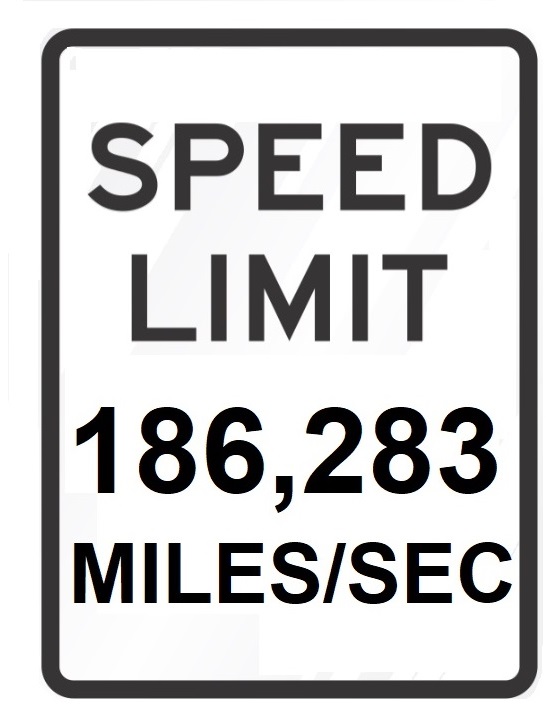 Doppler analysis suggests the more distant galaxies are moving away faster than the speed of light. That is sorely frowned upon in the realm of contemporary cosmology, but to gravitational redshift fans, that substantially altered wavelength makes perfect sense. If you rest a white cue ball in a tall tube of cranberry juice, the deeper it sits the redder it appears The more distant the galaxy and the more gravity a wave encounters, the redder the shift. Forget stars, planets, moons, and asteroids, space isn't empty; it's populated by random particles. How many mass-laden obstacles would a light beam encounter in a multi-billion light year trek? But expansion theorists justify that excessive shift by reducing each galaxy's Doppler calculated speed by a fudge-factor determined by some hypothetical rate of spatial expansion. Another fudge-factor derived from a theoretical bout of hyper-inflation during the earliest moments of "creation" ostensibly explains how a 14 billion year old universe has a 46 billion light year radius - and that's only the observable universe. This circular reasoning was conjured into contemporary theory to avoid violating nature's speed limit.